


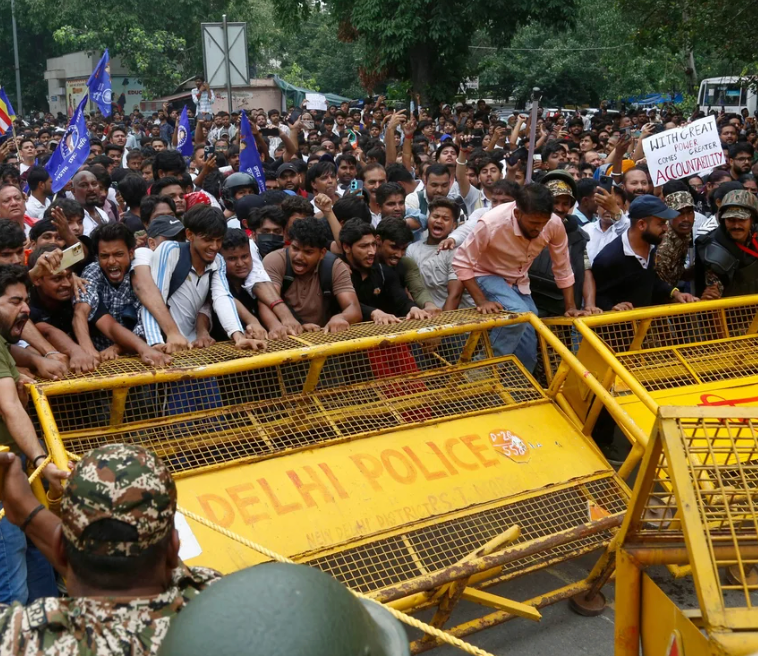
New Delhi: Thousands of demonstrators returned to the streets of the national capital on Tuesday, a day after clashes between protesters and police, signalling that the youth-led “Cockroach Janta Party” (CJP) movement is unlikely to lose momentum despite heavy security measures.
The demonstrations, centred around demands for education reforms and accountability over alleged examination paper leaks, have evolved into one of the largest youth-led protests witnessed in recent years. Participants say the movement now represents broader concerns about opportunities, governance and the future of India’s younger generation.
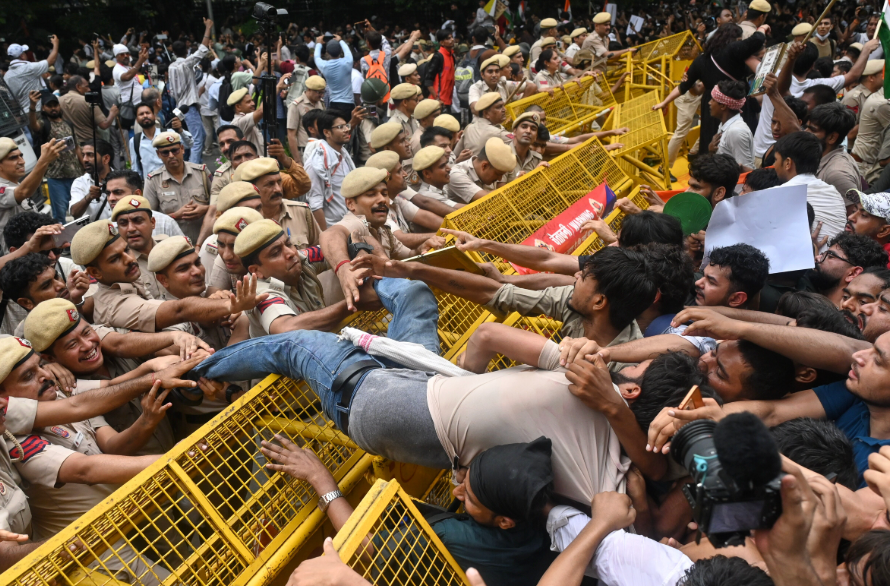
Many protesters gathered near Jantar Mantar, carrying banners and chanting slogans calling for reforms in the education system. Several also demanded the resignation of Union Education Minister Dharmendra Pradhan, arguing that repeated controversies surrounding competitive examinations have eroded students’ trust in the system.
Protests Continue After Monday’s Violence
The renewed demonstrations came less than 24 hours after large-scale protests in Delhi ended in confrontations between police and participants.
Authorities restricted protesters from marching toward Parliament, citing security concerns. Police deployed barricades and crowd-control measures in parts of central Delhi as tensions escalated during the day.
Several demonstrators alleged that the police used batons and tear gas to disperse crowds. Organisers claimed dozens of protesters sustained injuries during the clashes, while police maintained that force was used in response to attempts to breach security arrangements.
The events sparked widespread debate on social media, with videos and photographs from the protests circulating across digital platforms.
Young Protesters Remain Defiant
Despite Monday’s confrontation, many students and young professionals returned to the protest site on Tuesday, saying they would continue demonstrating until authorities addressed their demands.
Several participants travelled from different states to join the movement, describing the protests as more than a campaign against examination irregularities.
Many argued that the issue reflects wider frustrations among young Indians over education, employment prospects and institutional accountability.
Participants said the demonstrations would continue peacefully while urging the government to engage in dialogue.
Movement Expands Beyond Education
Although the campaign initially focused on alleged examination paper leaks, supporters increasingly describe it as a platform highlighting broader concerns affecting young people.
Activists say repeated controversies surrounding entrance examinations and recruitment processes have damaged confidence among students preparing for competitive careers.
Organisers believe the growing turnout reflects rising public concern over transparency and fairness within the education system.
Opposition Voices Support
The protests have also attracted political attention.
Opposition leaders criticised the government’s handling of the demonstrations and urged greater accountability over examination-related controversies.
Several political figures called for meaningful reforms aimed at restoring public confidence in the country’s education and recruitment systems.
Organisers Promise to Continue Campaign
Representatives of the Cockroach Janta Party said the movement would continue in the coming days, although they did not announce a detailed roadmap for future demonstrations.
According to organisers, discussions with government representatives have taken place, but they say key demands remain unresolved.
The Prime Minister has not publicly commented on the protests at the time of publication.
A Growing Youth Movement
Observers note that the protests have attracted participants across different age groups, though students and young professionals remain at the centre of the campaign.
Many demonstrators say the movement has become a symbol of wider aspirations among India’s youth, who are seeking greater transparency, improved educational governance and stronger institutional accountability.
As demonstrations continue in Delhi, authorities are expected to closely monitor developments while maintaining security around key government locations.